

John Glen MP delivers the annual Wilberforce Address
John Glen MP delivered the Wilberforce Address on 7 September 2026. The Wilberforce Address is an annual event hosted by the Conservative Christian Fellowship and attended by parliamentarians, church leaders and CCF members.
A transcript of John Glen’s speech is below.
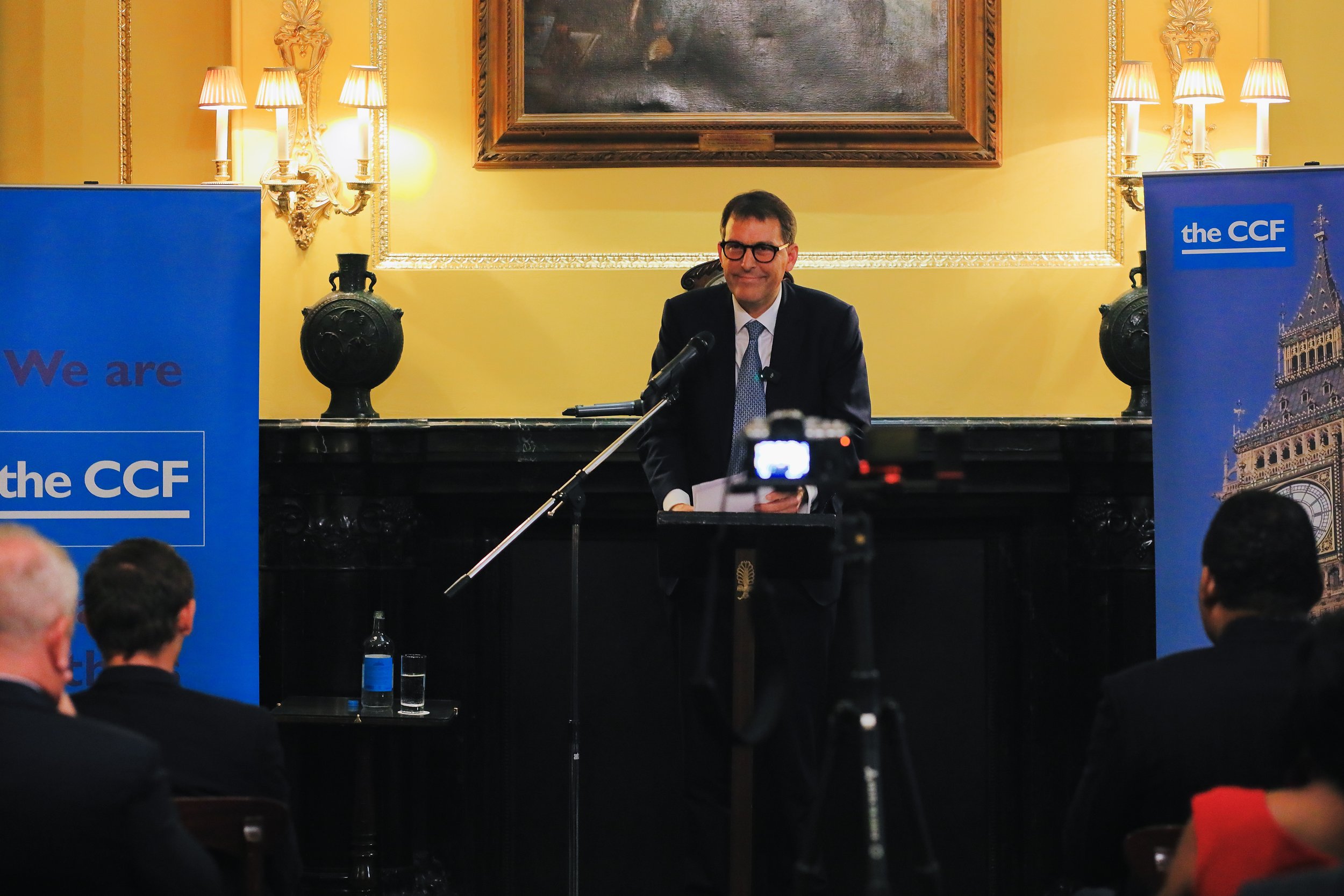
Friends, colleagues, and all of you in the Conservative Christian Fellowship, I’d like to warmly welcome you. I’d like to welcome the distinguished guests and all of you who support the CCF. It’s a great privilege for me to deliver this year’s Wilberforce Address.
I feel particularly honoured to speak, not only because it is where I made my earliest friends in politics and it’s where I found my political home, but also because when I reflect on my career to date, I realise that I have spent the better part of thirty years wrestling with the subject I’m going to address this evening: the growing threat of Christian nationalism to the effective witness of our faith.
And how best we respond to this, as followers of Christ in the political sphere
I believe that Christian nationalism is of particular interest to all of us who seek to remain faithful in our discipleship while outworking the political calling we have.
Many of us will have noted, I hope with a degree of concern, how our shared faith has been used in both Europe and North America as a way to appeal to the frustrations and fears of many voters who feel dismayed by the performance of their government and that their way of life is under threat or disappearing.
Sadly, rather than presenting the eternal hope of the gospel, we have seen how Christianity can be co-opted to further political and ideological ideals. Rather than calling people to the person of Jesus, they are called to an agenda which claims to operate in the name of Christ yet merely furthers human ambition.
I’ve spent my career attempting to work out how faith and politics work together, as other colleagues have in this room.
How they work together as a force for good.
When I first visited Parliament in 1985 with my late father, I was so struck by all that the Palace of Westminster represented - bythe grandeur of the architecture, the footsteps of great political figures echoing through the very fabric of the building - that I decided that was the path I would seek to take. Now that passion for politics has never gone away, despite the many seasons since that inspiring June day at PMQs with Margaret Thatcher in 1985.
In February 1996, I attended St Ebbes Church in Oxford for a mission event with the visiting Australian preacher John Chapman.
‘Chappo’, as he was affectionately known, challenged the assembled congregation on the historical truth of Jesus’s death on the cross. And the need to make a response—was He mad? Was He bad? Or if it was true, and He was who He said He was, hadn’t we all there better do something about it?
And in that moment, by God’s grace, at age twenty-one, I came to understand my need for Jesus Christ and the wonderful gift of His grace to me and the offer to humankind. I returned to my room in Mansfield College and though I saw no flashing lights or visions - in my heart I was determined to follow Christ in my life thereafter.
Very soon after, I was informed about the CARE internship. After interviews, a few weeks later, I interned for two Conservative Christian MPs, Sir Gary Streeter and Michael Bates, now Lord Bates and have since strived to approach my politics through the lens of my faith in all that I do. This has not obviously always been easy, and I’ve certainly not always got it right. I’m certain of that. Reconciling worldly ambition with his plans, trusting God’s timing in seat applications was a particularly difficult season - over ten years. And sometimes I’ve even questioned if politics is really the best use of my modest talents. But despite those ongoing tensions, I’ve now been an MP for 16 years and currently have the privilege of serving as an aide to our party leader.
Before going any further, I would like to make honourable mention of my dear friend and constituent Tim Montgomerie, who stands at the back of the room this evening.
Tim and I have enjoyed a long-standing friendship, even though our party politics may recently have diverged. Faithful friendship should transcend political realignment, and I think there is something very special in that. In the same way, politics can divide; the gospel transcends. Christians are bound together, even if we disagree politically because, if we are not, then we have allowed our politics to occupy a place that belongs to Christ.
This brings me to the example of William Wilberforce - the person these lectures honour. There are few greater exponents of British evangelicalism in politics than Wilberforce. The Christian faith for him was not merely an identity marker but a real and lived transformation. Wilberforce understood the responsibility that comes with being a Christian in the public sphere, and he dedicated his life to outworking his faith through his politics. It is remarkable to think that soon after his conversion, Wilberforce sought counsel from his friend John Newton, wondering whether he should resign from politics and enter ordained ministry. Newton encouraged him to remain in public life, anticipating – perhaps - that God had great plans for this young MP. And so he did! The abolition of slavery, animal welfare, and the RSPCA, social reforms across the spheres of labour, education, and health can all be credited and traced back to his dedication and expansive mission in public life.
Wilberforce was deeply shaped by his evangelical faith. Historian David Bebbington developed a framework in the 1980s which I find helpful: as an evangelical, Wilberforce embraced the supreme authority of Scripture; he had personally experienced an encounter with Jesus Christ that transformed him entirely; he recognised the centrality of the cross in his salvation; and because of this he was compelled by faith to actively seek the transformation of his own society.
Britain in Wilberforce’s lifetime was not devoid of challenges. The slave trade famously marked this era, but Britain also faced social decay, growing inequality, and protracted war. Britain was a country that needed the hope of the gospel, and as an MP Wilberforce offered what he had: a life that reflected, and indeed was compelled by, this very hope. Rather than seek power for its own sake or merely advance his preferred ideology, Wilberforce understood that Christ stood above his own personal agenda.
As I look at the challenges before us today, I find myself recognising that there is still much to learn from this giant of the faith. Before we do so, however, it is important to define what I mean by the term Christian nationalism. Nick Spencer, the distinguished senior fellow at Theos, has observed that “Christian nationalism can sometimes feel like a dustbin term into which people (Christians and non-Christians alike) throw all the things they don’t like.” In fact, many of those who are accused of being Christian nationalists reject the term outright.
By Christian nationalism, I mean the attempt to bind Christian identity to national identity in such a way that Christianity becomes a means of recovering, legitimising, or exercising power.
There is a temptation to use the cross and invoke Christ in order to curry favour and gain political support. I am concerned that as our political landscape appears to undergo radical change, this temptation will prove too much for many of us who, with very good intention, step into public life whilst proudly asserting our primary allegiance to Christ. Perhaps believing that the best way to serve Jesus is to hold - or even gain – power, the risk is we can be drawn into using our faith to secure the Christian vote. Thus, Christ is upheld not as the King of Kings and Lord of Lords, but a symbol around which we can rally voters.
At the same time, I do acknowledge that there is a very real tension at play in this. The salience and prominence of Christian institutions within our culture have, beyond any doubt, diminished over decades. Secular liberal individualism has, in part, contributed to the erosion of the place of the Christian faith in our public and cultural life, though the blame cannot solely be found there. I share the same longing that many of you will have to see churches flourishing and the Christian worldview continuing to shape our laws, policies, and way of life, as it has for millennia.
But does it follow that if we were to return Christianity to a place of prominence within our institutions, we would somehow see a revived nation? Danny Kruger, still my friend, and neighbouring MP in Wiltshire, eloquently argued in the House of Commons in July last year for the profoundly Christian origins of our institutions and national story. And there was much in his diagnosis with which I agree. Christianity has shaped this country in ways that are impossible to deny. Where I become more cautious is when the preservation or restoration of those institutional expressions begins to carry a greater burden than they can bear - as though recovering the symbols and structures of Christian Britain might somehow recover the society that once cherished them.
In his book, A Practical View of the Prevailing Religious System of Professed Christians in the Higher and Middle Classes in this Country Contrasted with real Christianity - a snappy title - Wilberforce explored these ideas and challenged us with the uncomfortable question that the rise of Christian nationalism should prompt us all to consider: are we confusing a country in which Christianity is represented, with a country in which Christianity is lived?
We can see the influence of Judeo-Christian values in the fabric of the nation, and of course we are comforted by the notion that we have an established church, and Christians of all denominations are undoubtedly reassured by the bishops present in the House of Lords. But when we look around at how progressive societal views are represented as ‘accepted opinions’, if we consider the challenge that many of my colleagues received in the House and in the media when debating the assisted dying bill over their right to express an opinion informed in part or fully by their Christian faith, and when we remember that only six per cent of adults attend a church service weekly, we have to be honest with ourselves.
The difficulty Christians have with this stark reality means we are vulnerable to the allure of politicians’ favourite phrases, such as ‘Christian values of family and personal responsibility’, or ‘cultural Christianity’ which I feel often stand up to very little scrutiny under inspection. So, not only do I reject Christian nationalism as a corruption of my faith, I reject it as a solution to this sad reality.
If we reach for God in politics, we will be disappointed. No manifesto can prescribe what humanity needs. For that, we have the gospel.
Because in politics we deliberate and decide on policies that impact families, communities, our national security, and our prosperity - but in all of that we are responding to something broken and imperfect. As Christians, we understand profoundly that it is human frailty and weakness that creates our problems. We would therefore be fools to believe that imperfect as we are, we have the perfect answers in one political party or set of policy prescriptions.
Is the answer to small boats that we must guard against a tide of Muslim immigration to protect our Christian inheritance, or is it to embrace those seeking refuge from war and bring them into our homes? Which Christian is right—the Liberal Democrat or the Conservative? I thoroughly reject the statement once made by the late Conservative MP Harry Greenway that “Jesus was a conservative” – we know His kingdom is not of this world.
I prefer to quote a Catholic here, the late Anne Widdecombe, who said, “We should be modelling ourselves on Christ, not modelling Christ on us.” If we forget this, we risk turning faith into a divine endorsement of any political outcome we desire.
So, when I speak of Christian nationalism, it is this very argument that concerns me: the idea that once we enjoyed a utopia of ‘Christian Britain’ and that, by reviving our institutional faith, we will return to such a state. My question is simply: When precisely was this utopia? Was it before Blairism? Did it start at the point of the global financial crisis? Before small boats? Before the swinging sixties? How far are we rewinding? Because I would argue that wherever we stop the tape, we find human society, human beings, mired in sin, we find injustices, we find social frailty - but expressed in different ways in those different seasons of our history.
Surely it is a fallacy to say that we have fallen from some recent Christian utopia. I believe Christian nationalists are clamouring for something which never existed. If the question we are investigating is ‘where did it all go wrong?’, then the honest answer, surely, is ‘in the Garden of Eden!’. After all, our problem is ultimately not that Britain has moved on from some ‘golden age’. Our problem is that humanity has strayed from God.
So, if no past utopia exists to which we can reach back and attempt to recreate our present day, what should our response be? I have learned over my time in politics that it is a mistake for politics to reach into Christianity in an attempt to legitimise itself. Instead, Christianity must reach into politics and transform it. I am not arguing for less Christianity in politics. It was Alastair Campbell, answering for Tony Blair, who famously said, “We don’t do God.” Well, we are the Conservative Christian Fellowship. We do do God, but how we go about that - and to what end - matters.
Gladstone made the powerful point that the Christian ethos of Parliament depends on the “personal character of those elected” not merely on professions of faith. If you think about that statement, there is something distinctly uncomfortable about it because, in many ways, structures are easier; we can campaign to preserve institutions, we can put Christian language into statute. But faith language as a badge of identity is sterile and what we build will lack roots and will wither under closer examination without a living faith behind it.
In other words, how we carry and represent Christ in political life is ultimately more powerful than turning politics into a battle to restore Christian identity.
As I have reflected on Danny Kruger’s speech, I noticed that while his words last July in the chamber indeed had significant impact, particularly among Christian audiences, his steadfast work in resisting the assisted dying bill alongside fellow MPs from other parties, such as Rachel Maskell and Jim Shannon, has arguably had a far greater impact in terms of his witness. When we stand up for what we believe in, despite the opposition we face, and hold fast to the truth which unites us, society takes notice.
Wilberforce rejected the assumption that Christianity was merely something inherited by birth, culture, or nationality. He was not interested in maintaining a mere sense of Christian identity. He worked tirelessly to see true conversion and transformed lives. His example resisted the pursuit of the appearance of godliness without embracing its transformative power. As Paul warns us in 2 Timothy 3:5 that there were those who have “the appearance of godliness but deny its power. Avoid such people.” This is a distinction that I think remains pertinent today.
Think again of Wilberforce’s Britain: far more outwardly Christian than today, yet it was also a society in which he had to devote much of his adult life to ending Britain’s preoccupation with the slave trade and addressing social decay. His response, in choosing to remain an MP after his conversion, was to seize the opportunity to serve and glorify Christ as well as he possibly could through a career in politics.
I cannot think of many better examples of faithful Christian representation in politics than his. Though it cost him - in his relationships, reputation, and resources - he served Christ before party, flag, or any other allegiance, untempted by personal ambition. That is the kind of Christian service in politics our country so desperately needs more of today.
The question that we should all ask ourselves is this: do I take my faith into every moment, every encounter, every opportunity that I am given? Whether you are an MP, an aspiring MP, a councillor, a civil servant, whether you work in business or in the charity sector, if you teach or mentor or whatever you do, every day brings with it the chance to carry our faith in such a way that the grace, mercy, and transformative power of Christ is evident.
I have worked with faithful Christians in all parties who are moved to express their faith in public life and who have nevertheless drawn very different policy prescriptions to those within our party. I often think fondly of the friendship and fellowship I found with the late Frank Field. Frank was always deeply motivated by his faith. We worked together on the All-Party Parliamentary Group on Hunger and Food Poverty. Many of the underlying questions around self-sufficiency and the proper functioning of the welfare state that we examined together were intensely politicised, verging on toxic at times, but we could always acknowledge political disagreement without allowing our shared mission to be derailed by them. We forged a practical alliance around shared values and concern for people who are suffering.
I think of one of my constituents who, through the conviction of his Christian faith, has dedicated his life to serving one of the communities in my constituency in which he lives. Observing the problems that arise after family breakdown, he strives to make a difference where he can, advocating for the nuclear family, even when this is very uncomfortable. He, of course, regularly encounters people whose lives and convictions differ profoundly from his own. And yet engages openheartedly with whoever needs love and grace, never withholding service and compassion. That kind of service moves me as I consider the broad range of views across the constituency I represent, where many disagree with my politics and don’t share my faith. And I hope, in some small way that regardless of this I too am working to uplift and transform lives.
In considering the rising phenomenon of Christian nationalism, the responsibility to respond faithfully falls to all of us. In Wilberforce’s words, we must allow our faith to “moderate the insolence of power” refusing the temptation to believe that political victory is proof of Christian faithfulness. We must extend grace; our opponents are people to love, not enemies to destroy. We must hold fast to the truth revealed in Scripture and not be swayed by the fickle opinions of the world. We must serve with kindness, and yes, we must be courageous when conviction demands a cost.
Our country will not see a great Christian revival by any imposition in our institutions or legislating Christian language, but through hearts transformed by grace. Ladies and gentlemen, it falls to each of us to consciously choose to serve Christ before any party, and especially before our own desires.
Sustained by his faith, Wilberforce saw the fruits of his work with the abolition of slavery some forty-six years after he began the campaign. If Christian nationalism is not the answer today, we are left with the somewhat exhausting realisation of just what is required of us. For that reason, I would like to close by sharing with you some of the words John Wesley wrote to Wilberforce five years after his conversion.
“Unless God has raised you up for this very thing, you will be worn out by the opposition of men and devils. But if God is before you, who can be against you? Are all of them together stronger than God? Be not weary of well doing. Go on, in the name of God, and in the power of His might.”